Saturday, January 7, 2012

Savannakhet - The Stone House and Garbage Overload

On the 31st of December, 2011, the last day of the last year before the World-Is-About-To-End for the umpteenth time in living memory, we travelled south to visit a site ominously named The Stone House following attractive road signs put up by the Lao government to promote tourism. The Stone House, it turns out, is a pre-Angkorian temple standing there by the river. It juts out of the soil, out of nowhere.

It is filled with statues of the Buddha which have been so worn down by time that all that often remains is a pair of drooping shoulders around which a sash has been draped.

Since the Government of the Lao PDR has gone to great lengths to promote tourism to the country I would humbly request it do something to educate the population as to the damage caused by the infestation of plastic bags and garbage strewn just about everywhere.

It is getting too much. At one point we drove to a “scenic spot” on the Mekong but had to wade through mountains of garbage just to get to the banks of the river. The air is filled with the acid smell of burning plastic.

Garbage, and how it is treated, is an ugly mark on this magical land.


Savannakhet - The Countryside


A trip through the countryside.

Curving red lines of road through the flat Mekong Plain; sleeping eternal villages, a sign pointing to cock-fights. A bridge from here to there.

At one point we stop at a village known for its weaving. Pots of boiling indigo, people passing in the streets as the dust kicked up by trucks settles on the dusk filled lives. The land here is constantly at battle with the people: it is either a glaze of mud during the rainy season – a thing you pull your feet out of as it sucks you in, or it is a floor of dust ready to fly into your home, nose and mouth at the slightest whisper.

Earth for these people is not a green garden with roses and forget-me-nots, it is a struggle.

The hills are a majestic one-ness with the sky; the colours blend and contrast with divinity.


Savannakhet - Country Folk


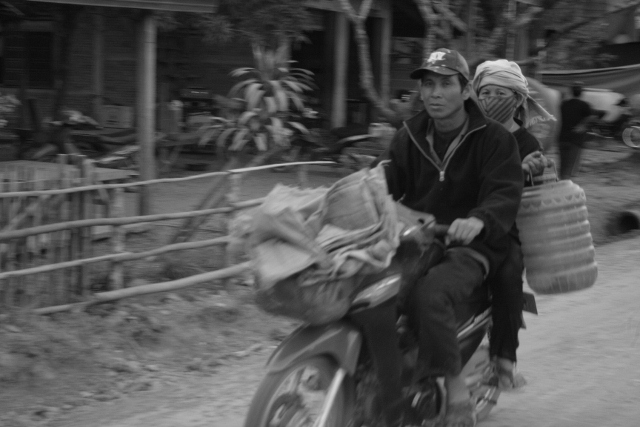
Country People

They pose or they move.

There is a forever simplicity in their gestures and a generosity in their regards. An eternity in their glances.


They are the greatness of the land, the salt of the earth.

I can never thank the Lao enough for being who they are and welcoming us into their land and their hearts.

Tuesday, January 3, 2012

The Best Pork Soup In Vientiane And Possibly The World!


In my continuing series of the best places to eat in Vientiane, it is with great sadness that I must announce that the fabulous chicken soup place near our house now seems permanently closed. The people still live there but they are no longer serving soup. Another great eatery bites the dust.


But, right across the street from the school I work for is a restaurant to die for. When I first went there it was no more than a hole in the wall and now it is a bigger hole in the wall.


Their pork soup is really the main attraction: the pork is nice and crunchy, the noodles are cooked to perfection and the greens are fresh. The pale meat balls melt in your mouth. On the table is an assortment of local spices and condiments that I have grown used to. Of course, I don’t really understand why there are both wet and dry chilli powders, not to mention a chilli paste, but the effect of chilli on the soup is electrifying. On very hot days the Lao pile this stuff on and it makes them sweat and even causes their eyes to tear and they will sit there and look like they are suffering, wiping themselves down with tissue paper. There must be some reason why they subject themselves to what seems like torture, so every time I eat there I add just a bit more chilli to my soup to see if I can crack the mystery.


This soup is so filling that I find if I have one after my morning class I feel no hunger until dinner time.


The lady who is the reigning spirit of the place is always smiling and pleasant and she gives you a breath mint with your change.

Cost of soup: 8,000 KIP or 1 American dollar. Drinking water is free. Reservations are not necessary. Visa not accepted.