Wednesday, September 22, 2010

Yom Kippur in Bangkok - Part Two - September 23rd, 2010


Being there


I have always liked Bangkok and for many years I had a trace memory that even the garbage in Bangkok smelt rich and plentiful, redolent and promising. But the Bangkok I found was only a pain in the ass. Kao San Road, where I had to stay to be close to the Chabad House, is just a tourist junk stop. T-shirts with ‘I (heart symbol) Bangkok’ abound, as do shirts with LaoBeer, or other cute and innovative messages (Giraffes’ Union Against Ceiling Fans) that just tire me. It was drudgery. There are even some Indian Swamis pretending to be cosmic and at peace with the universe (sitting and smiling like the Cheshire cat) so as to rip off some unwary tourists, like the kind I had met in Delhi.


At one point I had to go by taxi to the computer super store and was there placed face to face with crass commercialism at its most desperate degree. Five floors of sales, noise, canned music and aggressive sales. The taxi ride itself was interesting. Bangkok is simply a city that never, ever ends. The train ride out confirmed that impression. It goes on forever. Some people live in tin shacks and others live in luxury. But it never ends.


Yom Kippur itself I will not discuss. It is too personal. It was simply wonderful to speak Hebrew again and feel that part of me that is ‘us’. I guess I am a strange sort of animal, a fish that swims in many waters: at home with the French, at home in Hebrew and at home in English and yet truly never at home anywhere.


The fast was easy. It gets easier every year.


That evening after the fast I decided to go into town and see Bangkok by night. I suppose that this was a huge mistake because when I finally got back to my hotel room I had spoken with a lot of people. I had spoken with old Swedes and old Englishmen and old Americans who were spending their lives fucking whores. I spoke with whores who told me how unhappy they were, and how business is business.


The city is full of rats. They prowl through the parks. They cross the streets. I was really beginning to miss little Vientiane with her unpaved roads and innocent smile.


Strangely enough, the only Thai people I met that night who were simply delighted with their lives were the lady-boys. They seemed perfectly satisfied to be who they were and doing what they were doing (“You can fuck me then I can fuck you!”).


But I am neither an old Swede nor an old Englishman nor an old American. I am an old Jew, and this was no place for me.


The next day was a long one. The only memorable experience was getting my feet cleaned by Turkish fish. It tickled. It was nice.


Yom Kippur in Bangkok - Part Three - September 23rd, 2010


Getting Out


Kao San Road travel agents emphatically told me that getting the express bus to Vientiane was cheaper and more comfortable than going by train. The bus picks you up at your hotel, no need for messy and expensive taxi rides to the train station. And yes, it was much cheaper. In fact, they were so emphatic that I decided to take the train.


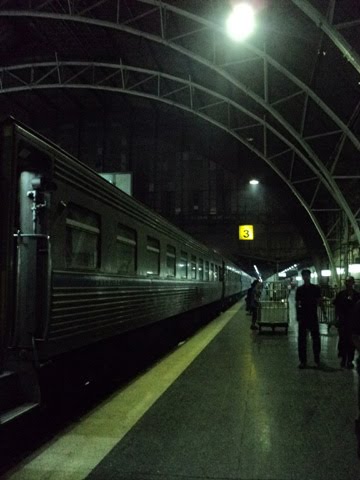
The usual. Comfort, clean linen. The occasional cockroach scampering across the floor. Dinner was served with a bottle of Singha beer.


At early morning I was looking out at the world through the double layers of glass protecting our air-conditioned world from rural Thailand. The train passed fields and flooded rice paddies. The rainy season had broken for the day and the skies were a brilliant blue with tints of clouds, heavenly fluffiness, on the horizon.


On a whim, without any forethought, I decided to jump train at Udon Thani (also spelt Urdon Thani) to check out one of the hospitals there.


Hospitals are a major priority in the Hyman household these days. In February we are going to have another baby and Vientiane may not be the best place for this to happen. She may be beautiful and have unpaved roads and be a little village, but we still want First World health care. While in Bangkok I decided that I did not want that name on my child’s birth certificate or passport or destiny.


Jumping that train was really the best part of the trip

It was a short walk from the station to the hospital and I was given a tour and presented with price options. It was clean and air-conditioned; spotless. Everybody spoke precise and balanced English.


I walked back to the station for the 11:44. Walking to the station was like walking through a valium haze, so thick was the heat and humidity. The train, when it did come, was only one hour late.


It was the most beautiful train I had ever seen.


I would not have liked being on it overnight, but for the hour ride to the Lao border it was perfect. It was old, with pull-down shades on the windows and ceiling fans and I was the only farang on board.


People were happy I was there, taking their pictures and I was happy to be with them, to be with the simple rural folk of Thailand, those who didn’t ride out of Bangkok.


I especially have to thank Rolling Stone magazine since they published on-line the 500 best rock ‘n roll songs ever written that I was able to download and put on my I-pod. This was a day for American music. I skipped over the Beatles and the Rolling Stones and Sting and The Police, because only Americans know how to capture that open road, the endless title they have to opportunity and their love of trains.


I only use my I-pod very rarely and this time it was gold. So many thanks to Bruce Springsteen (Baby, we were born to run…), of course Gladys Knight and the Pips (Midnight Train to Georgia…), Bob Dylan (Like a Rolling Stone…), the Beach Boys, Marvin Gaye, Otis Redding, Neil Young.


The whole thing smelt of freedom.


There was a little girl on the train who took great pleasure in sticking her head out the window and opening her arms to capture the open wind.


In her I was able to feel all the joy of youth, the endless possibilities that come with that boundless energy. The world and the heat and the poverty had not yet crushed her. Maybe they never would!


In the mean while she was free and full of wind. She incarnated the ecstasy of being alive and standing on the edge of life.

Monday, September 13, 2010

In The Early Morning Rain, September 13th, 2010


This is the monsoon. The rainy season. The Mighty Mekong is swollen like a muscle.


Vientiane is blessed with blue skies when it is not raining, unlike Hanoi where the sky is grey in every season, whether it is raining or not.


Yesterday, all day Sunday, there was no water in our house. The great cement tank in the garden was empty and the pump was turning on itself. We had to go to the neighbour’s yard to fetch washing water, and when you shower out of a bucket you realize how little water you really need and how much you really use.


At about midnight, the torrential rains started once again. Wonderful thing here is that in the monsoon it usually rains a little then stops, usually at night or in the early morning. The rest of the time the air is clear and refreshed; the vegetation is lush and generous.


When the rains started I was tempted to go outside and take a tropical shower. Then the lightning started and I changed my mind. There is no insulation under the roof, so when it rains the sound of it is direct and immediate; relentless.


The first time it happened we all ran outside onto the veranda and watched the rain design halos in the garden. The space around us was filled with a white as bright as pearl.

The Morning Market, September 13th, 2010


The Morning Market


If you didn’t know it were there, you could drive by it a thousand times and never guess its existence. And yet it is one of the throbbing hearts of the city, this strange Far Eastern Bazaar.

It has none of the graceful architecture of Near Eastern Souks and no trace of the Western European orderliness you find in the centre of medieval French towns. There is certainly conviviality, though, and middle-aged ladies sitting on canvas sacks behind their merchandise whisking flies away.

The Morning Market is a little bit of Sapa and a touch of Anatevka, lines of vendors protected from the sun and rain by improvised plastic awnings held in place by deteriorating string and gravity.

A lot of the vendors are Vietnamese, although how long they have been in Laos we have yet to ascertain. This area was not always peaceful, and notwithstanding foreign interventions, population transfers have been going on for centuries. A pogrom here, a burnt village there and somehow half the merchants in Vientiane turn out to be Viets.


This makes shopping easier for us since we have a common language. One funny thing about the Vietnamese is that if you speak to them in Vietnamese they will register no surprise or joy or recognition. But if you say just one word of Lao to a Lao, they will be all smiles and inclusion. But more about the differences between Laos and Vietnam in another post.


The market is divided into several sections. In the front are stalls with well organized merchandise: books, fabrics, kitchen-ware, towels, plumbing supplies.

In the back are the fruit and vegetable stands, meats and poultry and fish. If you could only open a fly concession you could make a fortune! A lot of the fish are alive, swimming in tanks. There are eels and frogs and little things that jump and crawl. Other ladies sell fish that’s ready to cook already placed in little bamboo steaming baskets but that does not look fresh at all.

The meats are laid out. Conversations with French ex-pats lead me to understand that the meat here is of good quality, although not aged, and therefore tough. If you want a good tender rib steak, for example, you should buy it at the morning market and age it yourself in your fridge. We tried that once in Hanoi with disastrous results.

This is where I went chicken shopping with Reb Dovid for Rosh Hashanah. You’ve got to make sure the chicken has been emptied and after we cleaned it and cooked it we found that it was tough as nails. The pomegranate we bought was over-ripe and bitter.

There has got to be a better way!

Another part of the morning market is indoor and air-conditioned and someone is building another modern air-conditioned thing right beside it. There you can find cell phones and i-pods and glasses and gadgets, “art work” and lighting fixtures. That’s where we went to get our Canadian cell phones un-blocked and where I bought ear-buds for my i-pod so I can listen to Bowie on my scooter.


Things to look for in up-coming posts: Driving In Vientiane; The Chinese Market; This Is Not Vietnam; Music; Pétanque, and many, many others!

Saturday, September 11, 2010

The Kids Are All Right - September the 11th, 2010


The one question we asked ourselves again and again before we left was: how will the kids deal with the move?


The question is a valid one, and yet as I spend more time with them I realize how resilient and playful they are. The move has clearly brought them even closer together, which is a pleasure to see.


Other pleasures:


Maya-Swann loves her school and her teacher, Chrystelle, and already has a boyfriend!


They love riding on tuk-tuks! Our mantra is “This Is The Life!!!” whenever we get on one, but since we rented motor-scooters, the mantra has switched to scooters.


Zephyr has a wonderful teacher, Veronique. The French system is tougher than the Canadian system and the emphasis is elsewhere, but he’s doing OK.


Right now he is playing with a toy helicopter I got for him at the Chinese Market (another, much weirder entry…), his reward for doing well in school last year and getting his yellow belt in karate.


Next weekend I’d like to get them out of the city to take a look at the real country in which we are living. What I really would like to is go to a place where they could see some elephants and some of the authentic village life of this place and maybe give them a sense that not everyone has a real house with real walls.


I would like to show them that we have a responsibility in this country and that there is more to life than the pleasures of the West. I want them to see what we have to learn from the Lao – their gentleness and their resilience, their strength and their softness. I want them to understand. And I wouldn’t mind understanding a little myself!

Friday, September 10, 2010

Our Home, September 10th, 2010


It is difficult to describe the joy of living in this house.


The place suffers from all the inconveniences of a twenty year old building in a tropical climate: the windows don’t open or close easily; the mosquito nets need to be coaxed into the door and window frames; the garden is a mess of neglect and is probably home to every species of poisonous snake Lao has to offer.

Also, it is not one of those traditional wooden Lao house of which we had dreamt, with their gleaming wooden floors and views over the Mekong.


No, this is an old French-style villa that looks like it had been ripped out of the arrière pays of Nice and planted here, between the banana trees and in the bottom of a rich tropical garden.

I say garden, but parts of it are more like a forest, especially the mysterious and shaded back of the house, where the Spirit House lives. We need a gardener of genius and independent thought and we need a maid!

The house is in the Diplomatic Quarter, which does have its own name in Lao, Thapalansay Village, Sisattanak District. According to Reb Dovid, it is an area of great spiritual power for the Lao, within biking distance of one of the oldest and most sacred temples in the area.

Our immediate neighbour is the Chinese Embassy who use their clout to keep the area quiet and clean and one of our garden walls, covered with a sort of ivy, is the retaining wall to their compound. On the other side is a tenement building housing several Lao families who seem to share washing and cooking facilities. Unlike a similar place in Vietnam, the area is relatively quiet. Any music they do play is not very loud and doesn’t have that maniac techno beat you hear all over South East Asia. Just down the road is a pétanque court. When I have a minute I will join the boys for a good game of bacchi.

But the joy of the house is just being there, waking up in the morning and walking down the driveway and looking at the tall tropical trees on both sides. Birds fly high in the sky. Yellow and black butterflies flutter.

In all the years we lived in Hanoi, I always dreamt of having a garden like this one.


In the distance there is a line of coconut palms, about 500 meters away, that kind of remind me of the opening scene from Apocalypse Now where you really get that feeling of strangeness, some-place-else-ness and foreignness that the Americans must have felt in the region.


We must have looked at about 15 houses before we chose this one. It was not the most beautiful or the best maintained. Other houses had views of the Mekong or of rice paddies. But Marie-Do saw the potential in this house right away, and she was right.


Funny things about houses in Vientiane:


This is the wet season. Many of the homes we visited had gardens that were totally flooded. Our garden was pretty dry, even after a heavy rain. One place we went to, you had to fight the mosquitoes in the middle of the day! You don’t want this in a malaria zone in the middle of a dengue epidemic.

If you go on Tony’s web site at http://rentstobuy.com you will see such descriptions as “on paved road” or “close to paved road”. When you look at this from Canada, as I did, you think, well, how bad can it be? The fact of the matter is that it can be pretty damned bad. People build these mega-mansions on dirt roads that are as level as the playing field of life and then they go out and buy massive Four-Wheel-Drive cars to access the mansions. If every owner were to donate just $500 to a street fund, they would be able to pave their roads and increase the value of their homes.


Having said that, we wouldn’t mind living in a house situated several kilometres up an unpaved road, except that Marie-Do is pregnant and getting increasingly pregnant by the day.


So paved roads are important. Our nearest paved road is about 400 meters away.

The whole city sits on the Mekong which twirls like a snake down to the Friendship Bridge, where you can cross into Thailand. The French School is on the Mekong, on its south-eastern bend on Kilometer 3 of Thadeua Road. Because traffic here is no longer the easy bicycle paradise it used to be (see http://www.eastofeden.fr for a look at it back then), it is important that we live within easy distance of the French School.


Finding this place was a miracle. Four bedrooms, a large luxurious garden, a huge living room, space for Marie-Do to have a studio and even a room where I can eventually stock wines.

Negotiations with the landlord were long and laborious. But we finally got the price we wanted and the terms we wanted. When the container finally gets here, I will post more photos of the interior. Then it will really be our home.

Right now the great salon is empty and every little noise echoes in it like a canyon. But soon, it will be full of our furniture. There will be dinners, and parties and wine and good food. There will be barbeques and dancing and singing beneath the stars. There will be full moon parties and new moon parties.


Thursday, September 9, 2010

On Rosh Hashanah May You Be Inscribed In The Book Of Life! September 9th, 2010


This year we are far from any Jewish community. I had kept contact with Reb Dovid, a Yid I knew from Hanoi, the kind of Jew who really believes in changing the world and making it a better place. Go figure.

So Reb Dovid and I went to the market on Rosh Hashanah Eve to do our shopping for dinner. Invited were also Hué, Reb Dovid’s Vietnamese girlfriend and Audrey who we met at the now famous Sasivad Guesthouse (the swimming pool has since been invaded by Germans, who stand in the water, beer glasses in hand…)

As luck, for is it all not just a matter of luck?, would have it, this new moon was also an important one for the Buddhists. The festival is called Hor Khao Pha Diin, and as I understand it, upon this day the Buddha opened up three worlds: heaven, hell and our world. One day someone will explain to me if the Buddha is just a really groovy man or a god or a demi-god. I am still having trouble understanding why people bow down and pray to a man who’s merit (great merit, I concede…) was to pass on to the Other Side while still in this life.


The day started with Marie-Do and me going off in all directions to buy enough table and chair space for our Rosh Hashanah guests. We visited a temple and then in the evening, just before we had our own apples and honey, we went to our local shul (The Ban Thapalansay Village Shteible) to join in the candlelight procession.


The entire neighbourhood was there. The girls were beautifully dressed and the boys all had Brillcream in their hair. At the temple entrance, flowers and candles were on sale. Who goes to their local shteible on Rosh Hashanah with money in their pockets? Not I! That didn’t matter very much because one of the monks came and offered us the ritual lulav.


Beautiful fresh flowers strung together with a candle and some incense sticks. When the candle burns down, it lights the incense stick. You take this in your hands, which are closed together in reverence, and circle the temple three times.


During the procession, a monk on a tower is smashing on an old drum. The beat of it sort of reminded me of all those old movies where the explorers knew something not good was cooking with the natives because of the hypnotic music coming in from a distance. At one point, the heroine falls into the hero’s strong arms and exclaims, “Oh, Brad! They are scaring me. Their music is driving me crazy! Please make them stop!!!”. The hero, Brad, knows that he can do nothing and that tomorrow he will probably be the thing not so good that is cooking with the natives. He looks off into the distance with white man’s impotence, his righteous rage against the savages contained only by his superior knowledge of his own limits.

But this is Laos. Smiles all around. And around. And around. We join in the procession and I pray for all good things for my family this year. Health, joy, prosperity. I pray for little Israel, and I pray for those who hate us, and I pray for little Laos and I pray for our little planet, enveloped as it is in madness and hatred.

This year I realized that I had something in common with everybody I could not stand. Every human being and I shared being alive at this very moment. Animosity or conflict of interest aside, we all share that bond.


I pray this year that this bond be strengthened